
Technology Competence
Photonic assembling and packaging
- State-of-the art assembling and packaging is the key to economic fabrication of reliable fiber optic components.
- Participate on 20 year experience in development and fabrication as well as quality and reliability assessment of
- Power Splitters
- Arrayed waveguide grating devices (AWG)
- Thermal DWDM
- Athermal DWDM
- VOA, VMUX
- Waveguides for sensor applications
- Power Splitters
- Consultants provide exceptional experience in PLC chip technology
- Consultants leverage proven track record in PLC chip mass manufacturing beating the cost benchmark of 100€ per 6 inch wafer under European fabrication conditions
- Consultants have access to international supplier networks enabling fab less approach for a quick start and stable base for technology transfer to China
- Consultants work internationally in Europe and North America
- Consultants leverage proven track record in outsourcing technologies to China and Eastern Europe
Power Splitters
Optical power splitters are planar light wave circuits which allow separating or combining light beams deriving from a variety of light sources. Power splitters consists typically of several cascaded Y-junctions where each of the junction attenuates the signal by appr. 3dB. This manipulation of light allows cascading the signal into many sub channels carrying all the same information. F.e. in telecommunication applications modulated laser beams are launched into the power splitters distributing then f.e. cable TV signals to a large number of end users. Besides this telecommunication application power splitters are also used in other areas such as laboratory equipment, media projectors and in camera systems. In principle power splitters are comparable to free space optic systems leveraging filters and partially reflecting mirrors sending part of the light beam along the optical pathway and reflecting the other part in an angled direction . As an integrated optical device power splitter fulfill this task much more elegant.
Arrayed waveguide gratings
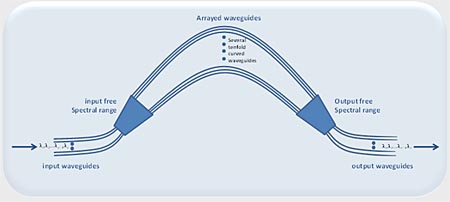
Arrayed waveguide gratings with the short cut AWG are extraordinary smart planar light wave circuits. They are also called grating routers, phase arrays or simply a phaser. AWG’s not only split a light beam but at the same time also separate a light beam into it’s individual wavelengths. The working principle is comparable to that of a prism. AWG’s have been invented in the early 90’ies and optimized to their perfection in the last two decades. An AWG consists of input and output waveguides, two so called free spectral range regions and an array of curved channels combining the two free spectral ranges. The two free spectral ranges work in principle as a Fourier transformation and thus the AWG is based on the principles of diffraction. The AWG can be used as a combiner of light beams carrying different wavelengths, called MUX. Being used as a splitter of a light beam carrying different wavelengths it is called DEMUX. AWG’s are popular in an overlay on passive optical networks (PON) delivering so called DWDM-PON network systems. Those DWDM-PON networks allow multiplying the transmitted wavelengths substantially enhancing the band width of the network system dramatically.
VOA, VMUX
A variable optical attenuator (VOA) is an important component in optical network systems. It enables controlling the signal level of the optical transmission and as a VOA array adjusting to equal levels among several optical channels. VOA’s are realized in integrated optical waveguide layout thus belonging to the family of waveguide devices such as power splitter and arrayed waveguide gratings (AWG). The function of attenuation can be realized in different forms such as interferometry based integrated optical tunable structures (f.e. Mach-Zehnder interferometer) or straight waveguides allowing attenuation by leveraging the electro optical effect or the free carrier plasma dispersion effect.
VOA applications are essential in WDM systems leveraging multiple add/dropp functions leading to a device called VMUX. A combination of an AWG based multiplexer and a variable optical attenuator represents a signal leveling wavelength selective AWG based splitter. The attenuator is reducing the power level to avoid overloading of photosensitive components in the optical network. The VMUX assures the intensity to maintain within the dynamic range of selected photosensitive detector array.
Waveguides for sensor applications
Sensor applications leveraging integrated optical waveguide devices provide reliable and cost effective solutions detecting environmental pollutions. Integrated optical sensors can also be tailored towards detecting biological compounds acting this way as bio sensors. Interferometry based waveguide layouts as well as straight waveguides can be used to realize sensor devices. In both cases the evanescent mode filed of surface waveguides is penetrating sensor layers on top of the waveguide altering the optical performance and transmission intensity of the waveguide circuit. The signal alteration is being detected and gives a direct information of the concentration of chemical or biological compound to be measured.
 +1(905) 251-3469